
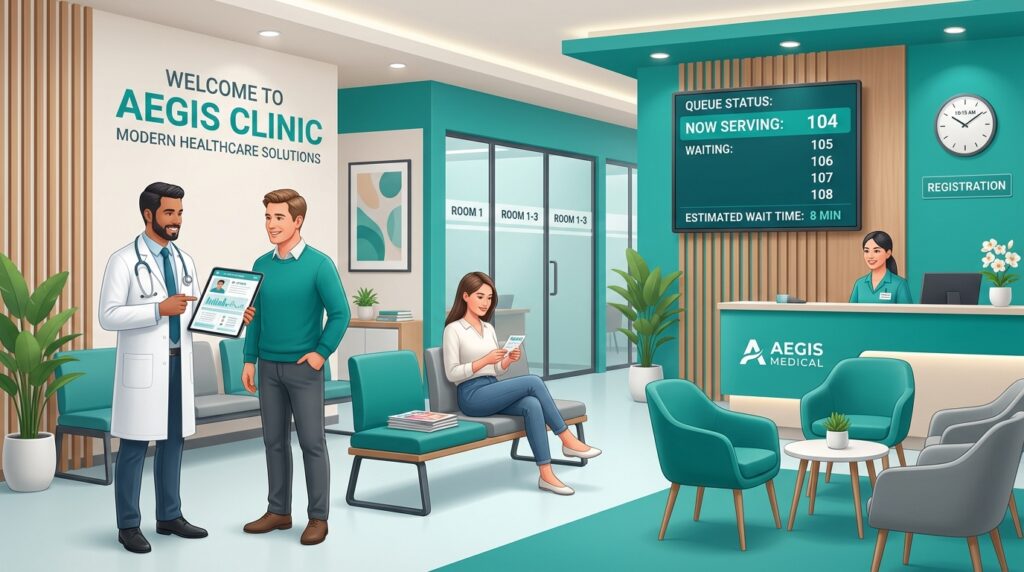
Patient waiting time is one of the most visible friction points in any outpatient clinic. Even when patients arrive promptly for their consultations, they often find themselves stuck in crowded waiting rooms for 45 minutes to over an hour. The problem is rarely a lack of clinical dedication; rather, it stems from fragmented coordination between registration, triage, doctor consultations, and billing.
Key Takeaway: The solution to chronic clinic delays is rarely “rush through patient consultations.” The most substantial improvements come from systematically eliminating the unnecessary 5–10 minute administrative lags that accumulate between each operational touchpoint.
The True Impact of Excessive Waiting Time
Long waiting times do not just frustrate patients—they create a compounding negative ripple effect across your entire medical practice:
- Decreased Patient Satisfaction: Patients frequently equate long waiting times with poor medical care, leading to negative online reviews and word-of-mouth complaints.
- Staff Stress & Overwhelm: Front-desk staff bear the brunt of frustrated patient inquiries regarding “How much longer until my turn?”
- Crowded Waiting Areas: Congested reception zones increase infection risks and create a chaotic, noisy clinic environment.
- High No-Show and Drop-Off Rates: Patients who anticipate prolonged delays are significantly more likely to cancel appointments or walk away before consultation.
7 Practical Ways to Reduce Patient Waiting Time
Here are seven proven, actionable strategies that modern outpatient clinics use to optimize their daily patient flow and keep queues running smoothly.
1. Implement Structured Appointment Slots
Many clinics still operate on an open walk-in system or vague morning/evening blocks (e.g., “Doctor is available 10 AM to 1 PM”). This inevitably results in a surge of 15 patients arriving simultaneously at 10:00 AM, leading to instant queue congestion.
Actionable Solution: Shift to structured, predefined time slots (e.g., 10- or 15-minute intervals). Stagger arrival times throughout the doctor’s consulting hours. This evens out patient arrival curves, allowing the front desk and nursing staff to manage patient intake predictably.
2. Separate Walk-In and Scheduled Patients
Walk-in patients are an inescapable reality for most clinics, especially in primary care, pediatric, and urgent care settings. The error many clinics make is dumping scheduled appointments and walk-in arrivals into a single, unorganized line.
Actionable Solution: Establish distinct tracks for booked appointments and walk-in patients:
- Reserve designated buffer slots (e.g., two 15-minute buffers per session) specifically for emergency or unscheduled walk-ins.
- Prioritize pre-booked patients for their allocated time slots while setting realistic waiting expectations for walk-in arrivals.
- Use an OPD management software that automatically balances appointments against open walk-in slots without disrupting doctor schedules.
3. Deploy a Digital Queue & TV Display
Uncertainty amplifies frustration. When patients cannot see their place in line, even a 15-minute wait feels like an hour. Furthermore, front-desk staff spend up to 30% of their time answering repetitive questions about queue status.
Actionable Solution: Replace handwritten registers with a digital patient queue and token system:
- Display the current patient queue or patient name list on a clinic TV screen, showing which patient is currently being attended to and who is next.
- Provide doctors with seamless doctor-side queue management to call the next patient with a single click inside their consultation screen, eliminating manual receptionist-to-doctor intercom calls.
- Give reception staff a real-time patient queue view to easily track patient arrival order, tokens, and waiting room flow.
4. Keep Patient History Digitally Accessible at One Click
Searching for physical paper files is one of the most frequent culprits behind consultation delays. When a returning patient arrives, receptionists often spend 4 to 8 minutes hunting down physical paper files, sorting through past prescription slips, and retrieving lab reports.
Actionable Solution: Centralize records with an intuitive digital EMR (Electronic Medical Record). When the doctor clicks on a patient’s token, their complete medical history, previous diagnoses, past prescriptions, allergies configured in the customizable EMR, vitals, and lab investigations appear immediately on screen. Doctors can review the patient’s background in seconds before they even step through the door.
5. Eliminate Redundant & Repeated Data Entry
In a conventional clinic, patient details are written down multiple times: once in the reception register, once in the doctor’s consultation notes, once on the prescription pad, and once again on the billing receipt.
Actionable Solution: Adopt a unified clinical platform where data captured at registration flows automatically across every subsequent touchpoint. Demographic details, contact numbers, and vitals recorded by the front desk automatically populate the doctor’s EMR and billing invoices—eliminating repetitive typing and eliminating transcription errors.
6. Accelerate Prescriptions with Smart Templates
For common diagnoses, doctors frequently prescribe identical medication combinations, standard dosages, and diet advice. Hand-writing repetitive drug names, strengths, timings, and instructions for 30 patients a day consumes up to 45–60 minutes of doctor time daily.
Actionable Solution: Utilize intelligent digital prescription templates tailored to your specialty. With quick templates, a doctor can generate an accurate, legible, branded digital prescription with full dosage instructions in under 30 seconds. This drastically cuts end-of-visit paperwork without compromising clinical thoroughness.
7. Improve Follow-Up Management & WhatsApp Communication
Patient workflow does not terminate when the patient exits the clinic door. Missed follow-ups, delayed review visits, and unexpected no-shows throw pre-planned schedules into disarray, creating sudden gaps followed by chaotic overcrowding.
Actionable Solution: Manage follow-up scheduling and patient communication directly from your clinic management system. Share appointment confirmations and follow-up consultation details with patients via WhatsApp, ensuring consistent communication and predictable arrival schedules.
Waiting Time Is a Workflow Problem (Not Just a Doctor Problem)
The most common mistake clinic managers make is assuming patient delays are solely the doctor’s responsibility. In reality, a patient’s total visit duration is composed of a continuous chain of interconnected touchpoints:
A 3-minute bottleneck at registration combined with a 4-minute file retrieval delay and 5 minutes of billing re-entry turns an 8-minute consultation into a 45-minute clinic ordeal.
Traditional Workflow vs. Connected Digital Workflow
To see the dramatic impact of removing micro-delays, consider the journey of a returning chronic patient under both operational setups:
The difference is not one single colossal automation—it is the elimination of dozens of small, friction-heavy delays that compound into massive queue delays.
Essential Patient Flow Metrics to Measure
As the management principle states, “You cannot improve what you do not measure.” Before implementing changes, track baseline metrics for at least two weeks:
Conclusion: Smarter Workflows Create Happier Patients
Reducing patient waiting time in your clinic does not mean rushing consultations or cutting corners on clinical care. Instead, it is about eliminating administrative drag through a connected digital workflow.
When appointment scheduling, digital queue tokens, EMR history, prescription templates, and billing speak the same language on a single platform, patient throughput increases naturally. The result? A calmer waiting lounge, less stressed clinic staff, and patients who trust and recommend your healthcare practice.
Make Your OPD Workflow Simpler with EZClinic Care
Manage appointment slots, patient queues, customizable EMR, 30-second prescriptions, billing, and WhatsApp patient communication—all from one intuitive platform.