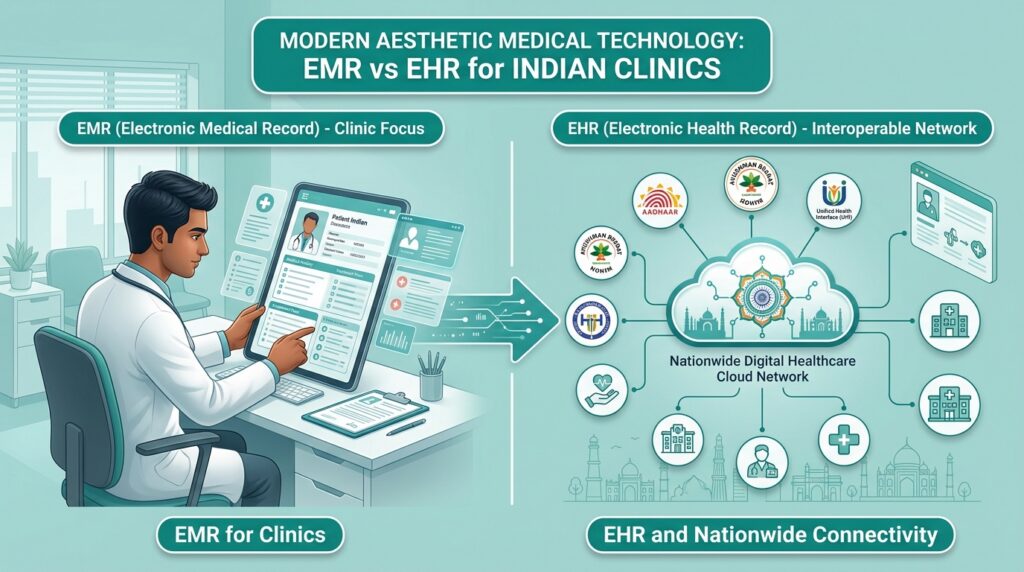
When doctors and healthcare administrators explore modern clinic software in India, they inevitably encounter two ubiquitous acronyms: EMR (Electronic Medical Record) and EHR (Electronic Health Record). While many software vendors use these terms interchangeably, they represent distinctly different architectural goals, scopes, and workflows.
The Core Distinction: An EMR is optimized for in-clinic efficiency and doctor consultation workflow within a single practice. An EHR is designed for longitudinal, cross-facility interoperability across hospitals, diagnostic labs, and India’s emerging ABDM digital health ecosystem.
What Is an EMR (Electronic Medical Record)?
An EMR is the digital equivalent of a patient’s paper chart within an individual clinic or healthcare practice. It captures the clinical encounter between the doctor and patient, serving as the central operational hub for daily consultations.
Within an Indian outpatient clinic, an effective EMR typically houses:
- Patient Demographics & Vitals: Age, gender, contact details, blood pressure, pulse, SpO2, BMI, and temperature recorded during triage.
- Consultation History & SOAP Notes: Chief complaints, clinical observations, physical examination notes, and provisional diagnoses.
- Digital Prescriptions: Medication names, dosages, frequencies, duration, instructions, and lifestyle recommendations.
- Investigation Orders & Lab Reports: Diagnostic test requests, uploaded PDF reports, radiology scans, and historical comparisons.
- Immunization & Allergy Records: Drug allergies, chronic conditions, and pediatric vaccination tracking.
- Follow-Up Schedules: Next appointment dates, review requirements, and clinical alerts.
Primary Benefit: Rapid, frictionless access to a patient’s entire medical backstory during an active 5- to 10-minute consultation—eliminating physical file searches and repetitive questioning.
What Is an EHR (Electronic Health Record)?
An EHR has a substantially broader horizon. Rather than confining data to a single clinic’s four walls, an EHR is structured to be a longitudinal, portable health record that travels with the patient across different healthcare providers, diagnostic centers, pharmacies, and specialty hospitals.
Key characteristics of an EHR include:
- Cross-Provider Interoperability: Seamless sharing of clinical summaries using standardized protocols (like FHIR and SNOMED CT).
- Holistic Patient Health Timeline: Consolidating cardiology records from Hospital A, pediatric charts from Clinic B, and blood tests from Diagnostic Lab C.
- Patient-Centric Data Ownership: Patients maintain control over who accesses their health records through digital consent managers.
- Emergency Clinical Access: Critical medical history (such as major allergies, blood group, and implant histories) available to emergency responders across facilities.
EMR vs. EHR: Side-by-Side Comparison
To help clinic owners and clinicians cut through the software marketing jargon, here is how EMR and EHR compare across key operational dimensions:
What Does an Indian Outpatient Clinic Actually Need?
While the grand vision of a universal nationwide EHR is revolutionary, 90% of a private clinic’s daily operational success depends on its EMR usability.
Consider the reality of an Indian OPD clinic managing 30 to 60 patients in a single 3-hour evening session. If a software system requires a doctor to navigate through 12 separate drop-downs and fill out 40 mandatory fields per patient, the consultation breaks down, queues back up, and the doctor reverts to handwritten paper notes.
During active consultations, a clinician needs software that effortlessly supports this rapid 6-step workflow:
Why Specialty Workflows Demand Configurable EMR Forms
A universal one-size-fits-all clinical form does not work across diverse medical domains. Every clinical specialty requires distinct diagnostic parameters and examination checklists:
A modern clinic management platform like EZClinic Care enables clinics to configure specialty-specific clinical templates, ensuring the software adapts to the doctor’s exact consultation style rather than forcing unwanted complexity upon them.
India’s Digital Health Revolution: Where ABDM Fits In
India’s healthcare technology ecosystem is undergoing historic transformation driven by the Ayushman Bharat Digital Mission (ABDM) launched by the National Health Authority (NHA).
ABDM effectively serves as the digital bridge between clinic-level EMRs and nationwide EHR interoperability through several foundational components:
- ABHA (Ayushman Bharat Health Account) ID: A 14-digit unique health identifier that links a patient’s medical records across public and private hospitals, clinics, and labs.
- Healthcare Professionals Registry (HPR): A verified digital identity repository for certified doctors, surgeons, and practitioners across India.
- Health Facility Registry (HFR): A comprehensive registry of clinics, nursing homes, hospitals, and diagnostic laboratories.
- Unified Health Interface (UHI): An open network protocol (analogous to UPI for financial payments) allowing interoperable appointment booking, teleconsultations, and digital health data discovery.
Strategic Recommendation for Clinics: When selecting software today, don’t merely ask “Does this have EMR?” Ask whether your platform has the architectural readiness and integration capabilities to connect with ABDM milestones, allowing you to future-proof your clinic without disrupting daily OPD speed.
The Clinic Owner’s Checklist: What to Ask Software Vendors
Before committing to any clinic management or EMR software, evaluate vendors against this practical 7-point checklist:
- Speed of History Access: Can I open a returning patient’s full diagnostic history, previous Rx, and uploaded lab reports in under 3 seconds?
- Customizable Clinical Templates: Can I tailor consultation notes, examination fields, and templates specifically to my medical specialty?
- Prescription Generation Speed: Can I generate a clean, branded digital prescription with dosage instructions and advice in under 30 seconds?
- Integrated OPD Touchpoints: Does the EMR natively sync with front-desk appointment scheduling, patient queue display, billing, and WhatsApp messaging?
- Multi-Device Accessibility: Can doctors securely access records from desktop PCs, laptops, and tablets during clinical rounds or home visits?
- Data Ownership & Portability: Do I retain 100% ownership of my clinic’s clinical data with the freedom to securely export records anytime?
- Digital Health & Interoperability Readiness: Does the platform support modern standardized data protocols and future ABDM connectivity?
Conclusion: The Ideal Formula for Indian Clinics
While the debate between EMR and EHR can seem academic, the answer for Indian clinic owners is clear:
You do not have to choose between clinical speed and digital connectivity. The ideal software gives you a high-speed, highly customizable EMR that saves your doctors hours of administrative documentation every day, combined with an extensible architecture capable of participating in India’s connected healthcare future.
See Customizable EMR in Action with EZClinic Care
Explore lightning-fast patient history access, specialty-tailored clinical forms, 30-second digital prescriptions, and unified OPD clinic operations from one intuitive platform.